News Center
Stay updated with the latest news and industry insights.
Argentina Native IP VPS Comparison: Which Plan Should You Choose?
2026-09-24 13:03:00 Native IP Argentina VPS
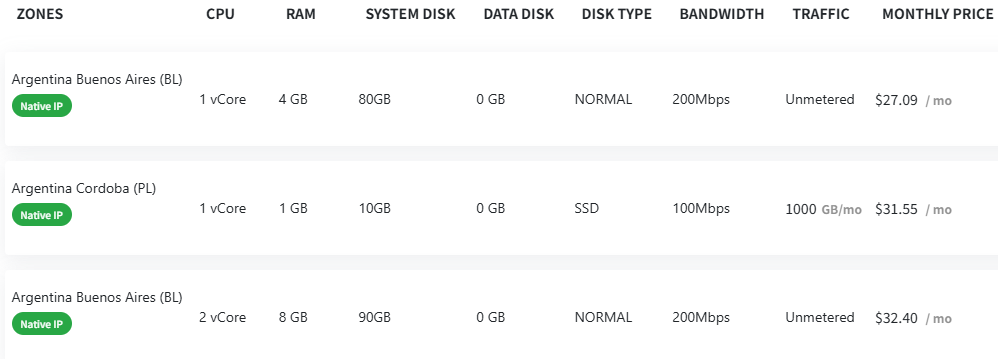
If you need an Argentina Native IP VPS, the configurations shown here are concentrated in Buenos Aires and Córdoba. All three plans provide a Native IP, but their CPU, RAM, storage, bandwidth, and traffic allocations are quite different.
Argentina Native IP VPS Price Comparison
Which Argentina Native IP VPS Has the Best Value?
Among the configurations shown, the 2 vCore / 8 GB Buenos Aires plan at $32.40/month offers the largest resource allocation for a relatively small increase in price.
Compared with the $27.09 plan:
CPU: 1 → 2 vCore
RAM: 4 GB → 8 GB
System disk: 80 GB → 90 GB
Bandwidth: 200 Mbps → 200 Mbps
Traffic: Unmetered → Unmetered
Price: only $5.31/month more
For applications that can make use of additional CPU and memory, this configuration provides considerably more resources without a large increase in monthly cost.
The $27.09 Plan Is the More Economical Choice
The 1 vCore / 4 GB plan in Buenos Aires costs $27.09/month.
Its 4 GB of RAM and 80 GB system disk make it suitable for relatively lightweight workloads that still need an Argentina Native IP.
It also has 200 Mbps bandwidth and unmetered traffic, matching the higher-priced Buenos Aires plan.
If 1 vCore is sufficient for your application, there is little reason to pay extra for additional resources.
How to Buy an Argentina Native IP VPS ?
Before choosing a plan, check these points:
1. Confirm the IP type — make sure the VPS actually provides an Argentina Native IP.
2. Choose the location — Buenos Aires and Córdoba may produce different network latency for your users.
3. Match RAM and CPU to your workload — 1 vCore/4 GB is enough for lighter applications, while 2 vCore/8 GB gives substantially more headroom.
4. Check traffic limits — the Buenos Aires plans shown have unmetered traffic, while the Córdoba plan includes 1000 GB/month.
5. Check storage type — SSD and Normal disk are different, so storage performance may matter for databases and I/O-intensive applications.