News Center
Stay updated with the latest news and industry insights.
Which UK Server Is the Best Value in 2026? Our Top Picks Compared!
2026-05-07 13:03:00 UK Server
When it comes to choosing a server in the UK, whether you’re setting up a website, launching an app, or just need stable hosting, the price-to-performance ratio is super important. So, I took a look at a comparison chart with five different server options situated in London, and here's my take on which ones stand out for value!
Here’s a quick breakdown:
1. United Kingdom London (X)
1 vCore, 1 GB RAM, 10GB SSD
Unmetered bandwidth, 750 GB traffic/month
$8.40/month
This one is super basic. If you just want a straightforward, affordable server for small websites or lightweight tasks and you don’t need native/residential IP or Windows support, this is a good option.
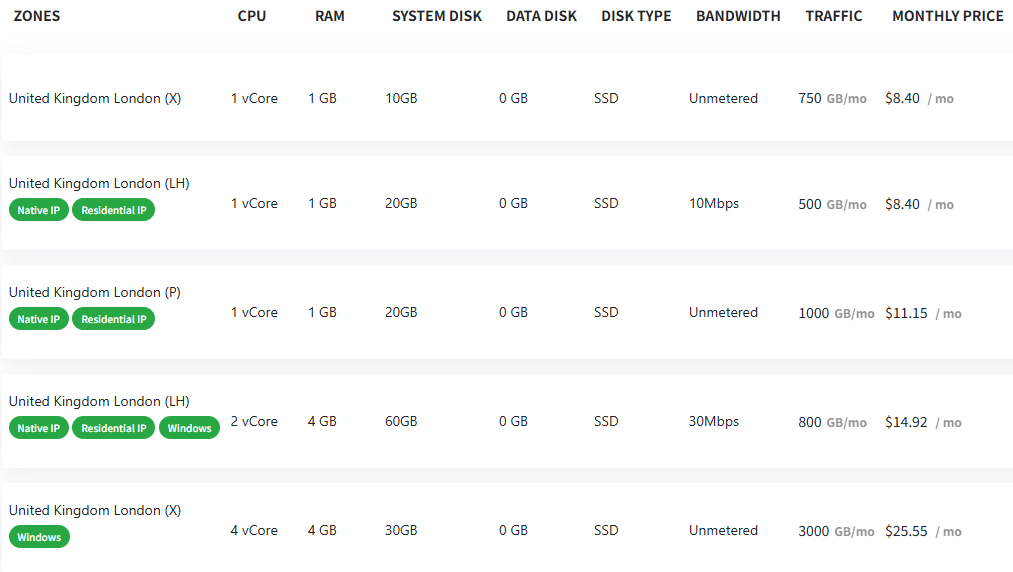
2. United Kingdom London (LH)
1 vCore, 1 GB RAM, 20GB SSD
10Mbps bandwidth, 500 GB traffic/month
$8.40/month
At the same price, you get double storage. But what really stands out are the Native IP and Residential IP tags. If you need to mimic a local UK residential environment (like for web scraping or certain applications), this is super useful.
3. United Kingdom London (P)
1 vCore, 1 GB RAM, 20GB SSD
Unmetered bandwidth, 1000 GB traffic/month
$11.15/month
Native IP + Residential IP
This one gives you both Native IP and Residential IP, plus more traffic. The price is a bit higher, but if IP flexibility and high traffic are important, it’s a good bet.
4. United Kingdom London (LH)
2 vCore, 4 GB RAM, 60GB SSD
30Mbps bandwidth, 800 GB traffic/month
$14.92/month
Native IP + Residential IP + Windows
Here, not only do you get better specs, but you also get Windows support. If your application or website requires Windows OS (like certain business software), this is a major plus. Native and Residential IPs are still here, so you get flexibility for different networking scenarios.
5. United Kingdom London (X)
4 vCore, 4 GB RAM, 30GB SSD
Unmetered bandwidth, 3000 GB traffic/month
$25.55/month
Windows
This is the powerhouse option. Tons of traffic and CPU cores, plus Windows support. However, there’s no Native/Residential IP tag, so if you need those features, check the other options.
So, which one’s the best value considering these features?
For basic projects, the first one is still solid—just keep in mind there’s no special IP or Windows support.
If you need IP flexibility (Native or Residential), go for the second or third options depending on your bandwidth and storage needs.
If you want top performance plus Windows and IP flexibility, the fourth option is fantastic—great specs, Windows OS, and both IP types.
The last one is perfect for heavy-use and Windows-based projects, but lacks specialized IP types.